In a society where menstruation has long been cloaked in silence, stigma, and discomfort, and often treated as impure, girls were traditionally expected to remain secluded away from kitchens, temples, and social spaces. What started as a response to biological realities, slowly and gradually evolved into a deeply entrenched cultural taboo and social practice.
Even though the reasons were both social and scientific, in pre-modern times the blood without injuries was mysterious and frightening. Menstrual blood came to be linked with pollution, odour, and was treated like a disease, mainly because of a lack of knowledge about reproductive biology. However, the problems were not just rooted in the social ignorance of knowledge but lack of practical challenges of hygiene too. Unavailability of sanitary napkins, improper access to a source of water, and limited access to distant wells and rivers made it difficult for women to maintain hygiene as well as their physical, emotional and mental health during menstruation. These practical difficulties, overtime became a subject of patriarchal norm and tradition, where the necessary precautions were interpreted as rituals of exclusion, eventually freezing deep into entrenched taboos.
Advancements in science gained their popularity and reproduction, but the biological system of the human body told a different story. Modern science defines menstruation as simply the cyclical shedding of the uterine lining and it’s a healthy sign for reproduction and not at all related to impurity. Menstrual blood is similar to any other bodily fluid physiologically and proper hygiene prevents infection and assures the well-being of the woman’s body. Awareness and education about menstruation held not only the point to empower girls but to reduce the process of reduction and absenteeism and to dismantle the social stigma.
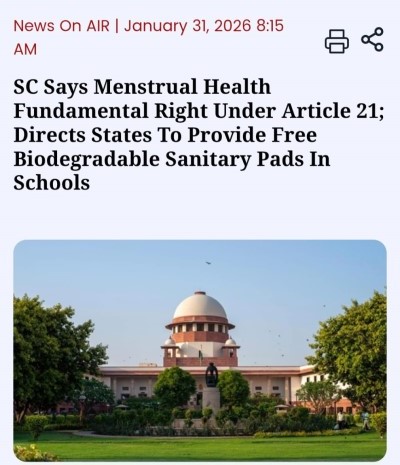
The silence finally broke the ice through the case of Dr. Jaya Thakur vs. Government of India (2026 INSC 97). Marking a profound constitutional shift. A subject treated as private and frowned upon by public discourse has now gained immense attention and recognised as a matter of fundamental rights under article 21, 14, and 21A. the petition was filed as a Public Interest Litigation under Article 32 of the indian constitution, to seek directions and ensure the provisions of free sanitary pads for the schoolgirls, separate toilets, awareness programs in schools and safe disposal machines and mechanisms as facilities. The petition acknowledged the critical issue of school absenteeism among adolescent girls, increased dropout rates, lack of prior information about menstruation and inadequate sanitation facilities. It highlighted the futile functioning of MHM facilities (Menstrual Hygiene Management). The union of India, in its response, admitted that menstrual taboos and limited access to sanitary products facilities, accompanied by the records of various policies for menstrual hygiene for school-going girls, such as “Menstrual Hygiene Scheme (MHS)2011, National guidelines on menstrual hygiene management 2015, Jan Rashtriya Kishor Swasthya Karyakram (RKSK) 2014, initiatives under Swaccha Bharat Mission (SBM) and Swaccha Vidyalay Abhiyan aimed to improve the sanitation infrastructure. Further, schemes such as the Aushadhi Scheme, Samagra Shiksha Abhiyan” facilitated affordable sanitary napkins, vending machines, and safe disposal mechanisms. Various state-level initiatives also complemented the efforts. However, even though the policies exist, their implementation remained an inconsistent and largely inadequate dream to achieve, as noted by the court.
The Supreme court recognised menstrual hygiene as an integral subject of fundamental rights under article 14 (court emphasised a substantive equality as the requirement to take positive measures by the states), article 21 (it expanded the right to life by including dignity, to encompass privacy, autonomy, and reproductive health) and 21A (court affirmed, right to education includes the removal of financial and system barriers). SC stated that menstruation should not hinder any girl’s education and justice to menstrual problems falls within the broader ambit of dignity, equality and participation.
The judicial analysis in this case was both comprehensive and transformative. It started with an affirmation that education is a “multiplier right,” and essential for all other fundamental rights. Judges observed that equality must be substantive rather than formal, and systematic barriers must be actively removed. The court issued concrete directions mandating provision for functional, gender-segregated toilets with water connectivity in all schools, and free distribution of Oxo-biodegradable sanitary napkins. Directed the NCERT and SCERT curriculum, with teachers' sensitisation and boys included in the campaigns to dismantle the stigma. And above everything, a monitoring and accountable mechanism to be established through district education officers and the child rights commission, ensuring that compliance is inspected regularly and enforced sincerely. This holistic approach linked dignity, equality and education with practical implementation and measures making menstrual justice a living constitutional reality.
Around the world countries have taken important steps such as Scotland providing free menstrual products to all, Kenya distributing pads in schools and New Zealand has many policies to reduce the absenteeism among girls. India had made a remarkable shift in history by making it a constitutional right, stating that it's no longer just a welfare measure of government but a legal entitlement that schools and authorities must provide. India’s Supreme Court ruling on menstrual justice directly connects with the international charters like Universal Declaration of Human Rights (1948), Convention on the Elimination of All Forms of Discrimination Against Women (CEDAW) and UN Sustainable Development Goals (SDGs), focused that every person should have an equal access to education, healthcare, and opportunities without any discrimination of any other fault. India has set a strong example of how local authorities can be directed while meeting the international standards of justice and equality.
The judgment is not just legal but cultural. By bringing menstruation into the constitutional ambit, the court has challenged the taboos that will help in reshaping the social attitude. Civil societies like Goonj, WaterAid, and UNICEF have complemented the efforts of the state in bridging the gaps in awareness and infrastructure. To empower girls and foster dignity in the daily course of pursuit.
“A period should end a sentence- not a girl’s education”
Dr. Jaya Thakur vs. Government of India marked a watershed in India’s constitutional journey. Situating the hygiene within the framework of fundamental rights, aligning national ideals with global norms. Most importantly, transforming rights from abstract guarantees into lived realities.
When a girl can attend a school freely without any stigma or limitation, the constitution is not merely interpreted in courtrooms but it is lived in classrooms, homes, and communities across the nation. This is the true promise of justice where a society’s dignity is practised daily and equality is woven into the fabric of ordinary life.
(This article is written by Arundhati Singh Chandel, Professor & Research Scholar on Mar 2026 for abvp.org)