
When the Supreme Court of India delivered its judgment on the Sabarimala Temple in 2018, it sent shockwaves through Hindu society. If you read the newspapers, watched television debates or scrolled through social media, the story was presented in a very simple, highly misleading way: as a battle between "modern equality" and "backward, anti-women traditions." The global media told the world that Hindu traditions inherently discriminate against women and that the secular courts had to step in to save them.
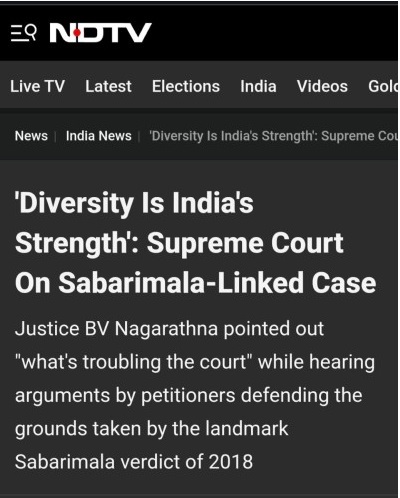
But as students, young intellectuals and the future leaders of this nation we cannot just accept the narrative created by mainstream headlines. We must look deeper and question the foundation of these claims. When we analyze the Sabarimala case through the lens of constitutional law, Bharatiya culture and sheer common sense, a completely different picture emerges.
This historic legal battle was never truly about women's rights or gender equality. It was about an organized attempt to interfere in indigenous traditions, disrespect the unique nature of a Hindu deity, and impose a Western idea of "rationality" onto our ancient faith. To defend our Dharma on college campuses, in courtrooms and in society, we must fully understand the legal and cultural truths of this case.
To understand what went wrong in the Sabarimala case, we first have to look at who actually started it. In the Indian judicial system, we have a powerful legal tool called Public Interest Litigation (PIL). Originally it was created for a noble cause: so that social workers could go to court on behalf of poor, voiceless people (like bonded laborers, under-trial prisoners, marginalized communities) who could not afford lawyers.
However, the Sabarimala case was not filed by the women devotees of Kerala who actually visit the temple. It was filed by the Indian Young Lawyers Association (a group of activists) sitting in New Delhi who had no personal faith in Lord Ayyappa, no connection to the temple and no understanding of its strict rituals. They used the PIL system not for genuine "Public Interest," but rather for "Publicity Interest."
This represents a very dangerous trend for our society. When the courts allow people who do not even practice a religion to challenge its most sacred rules, they open the door for continuous harassment of native traditions. If non-believers, secular activists and NGOs can dictate how a temple should be run, then no local tradition, no Agama Shastra (temple guidelines) and no community practice is safe from interference. It strips the local communities of their right to self-determine their religious practices.
At the very core of these practices is the legal and spiritual status of the deity Himself. The most important legal fact, the one that the media intentionally hides from the public, is that in Indian civil law, a consecrated Hindu Devata (Deity) is not just a stone idol. The Devata is recognized as a "Juristic Person" or a legal entity. This means that under the law of the land, the deity can own land, pay taxes, fight legal cases and possess His or Her own distinct fundamental rights.
At the Sabarimala temple, Lord Ayyappa is not worshipped in a general, omnipresent form. He has manifested there specifically as a Naishtika Brahmachari (an eternal, strict celibate undergoing severe penance.) The devotees who visit Him must respect this environment by undergoing a rigorous 41-day vratham (penance), observing strict rules of purity, celibacy, diet and isolation, culminating in carrying the sacred Irumudi Kettu on their heads through the dense forests.
The tradition restricting women of reproductive age (10 to 50 years) from entering the temple is not born out of some hatred for women. It has absolutely nothing to do with the colonial and Abrahamic idea that menstruation is "impure" or "dirty." Rather, it is a boundary established purely to respect the specific vow of celibacy taken by the deity at that specific geographical location.
If the deity has a legal identity, does He not have the right to maintain the character of His own home? To force the entry of all women into the Sabarimala shrine is not a victory for equality; it is a direct, forced violation of the Devata’s fundamental right to practice His vow. We must ask a basic legal question: Why are the rights of the deity completely ignored to satisfy the egos of urban activists?
The answer lies in the biggest weapon used against Hindus in this debate: the word "patriarchy." Activists claim that the Sabarimala tradition is proof that Hinduism suppresses women. This argument only works if you are entirely ignorant of how the Hindu temple ecosystem actually functions across the country.
Hinduism is not a monolithic faith. We do not have one single holy book, one single prophet, or one uniform set of rules for every place of worship. Sanatana Dharma is a vast, beautiful ecosystem of millions of different traditions. Every temple has its own specific energy, its own history, its own consecration process, its own rules of entry based on the nature of the deity residing there.
If Hindu traditions were inherently against women, how do the critics explain the famous Attukal Bhagavathy Temple in Kerala? This temple is proudly known as the "Sabarimala of Women." Every year, millions of women gather there for the Attukal Pongala festival and men are strictly not allowed to participate in the core offerings. Does the media call this misandry or male discrimination? No, because it is a tradition respected by all.
Look at the Chakkulathukavu Temple, where male priests ritually wash the feet of female devotees during the Nari Puja. Look at the Kamakhya Temple in Assam, which celebrates the menstruating Goddess, and where the natural biological cycle of a woman is worshipped as the ultimate source of cosmic creation. Look at the Brahma Temple in Pushkar, where married men are not permitted to enter the inner sanctum to avoid the wrath of Goddess Saraswati. Look at the Kumari Amman Temple in Kanyakumari, where only Sanyasis (monks) and women are allowed inside, while married men are barred.
Exclusion in Hindu temples is almost never about social discrimination; it is about spiritual discipline and the specific energy dynamics of that particular shrine. By forcing a uniform, Western standard of "equality" onto Sabarimala, the courts are ignoring the rich, diverse, and pluralistic nature of our Dharma. They are trying to fit our complex, living spiritual science into a narrow, imported and secular box.
Fortunately, this rich plurality was not entirely ignored by the judiciary. When the Supreme Court gave its verdict, four judges voted to strike down the temple's centuries-old traditions, but one judge stood firm against the tide. Her words provide the strongest intellectual armor for our civilizational battle. Justice Indu Malhotra who notably was the only woman on the five-judge Constitution bench delivered a powerful and brilliant dissenting judgment. Every student of law and defender of culture must understand her arguments.
Justice Malhotra showed immense constitutional wisdom by stating that in a secular country, courts should not act as religious clergy. She argued that matters of deep religious faith cannot be tested solely on the strict logic of Article 14 (The Right to Equality). Religion is fundamentally a matter of faith, devotion and emotion, not cold, everyday rationality. As she brilliantly noted, what may seem irrational to a secular mind is a matter of profound, unquestionable faith to a devotee.
She pointed out that under Article 25 and Article 26 of our Constitution, citizens have the fundamental right to practice their religion and religious denominations have the right to manage their own internal affairs. The followers of Lord Ayyappa (the Ayyappaswamis) form a distinct group with their own unique codes of worship. The state and the judiciary have no business stripping away these unique practices just because they do not make sense to a modern, secular mindset.
Justice Malhotra’s dissent was a bold warning: "Constitutional morality" should not be weaponized to erase the living, breathing traditions of the land. The Constitution of India was written to protect our incredible diversity, not to bulldoze it into a flat, featureless landscape of uniform secularism.
This defense of civilizational diversity was not just confined to dissenting legal opinions; it manifested powerfully on the streets of Kerala. Perhaps the most inspiring chapter of the entire Sabarimala saga was written not in the air-conditioned courtrooms of Delhi, but by the masses. When the verdict was announced, activists and liberal commentators expected women to celebrate this "liberation." Instead, something incredible happened that shocked the nation's media.
Millions of Hindu women came out onto the streets in massive protests. They launched the historic "Ready to Wait" campaign. These were the true devotees of Lord Ayyappa, and they proudly declared that they were perfectly willing to wait until they crossed the age of 50 to visit their beloved deity. They marched through the streets chanting Sharanam Ayyappa, proving that they understood the tradition, they respected the Devata’s vow of celibacy, and they fiercely rejected the fake sympathy of the activists.
This grassroots women-led movement completely shattered the feminist and liberal narrative. It proved that the masses do not want imported frameworks of liberation that trample on their spiritual heritage. The women of Kerala stood as an impenetrable wall of devotion protecting their Dharma, showing the entire nation what true civilizational pride looks like. It was a clear message to the establishment: do not try to "save" us by destroying our faith.
Ultimately, the Sabarimala case serves as a massive lesson for all of us. As the vigilant youth of Bharat, our battlefield is no longer just political; it is heavily intellectual and legal. We are witnessing a systematic legal and cultural assault on our institutions. If a unique tradition like Sabarimala is dismantled today in the name of modernization, tomorrow the same logic will be applied to other temples, other festivals and other sacred traditions until nothing unique is left.
We cannot afford to be ignorant or complacent. Emotional sloganeering alone will not save our Dharma in the modern world. We need sharp, intellectual assertiveness. We must study our Constitution, understand our legal frameworks and read Supreme Court judgments critically. We must be able to stand up in our classrooms, our university debates and our community gatherings to dismantle the false narratives of "patriarchy" and "backwardness" using logic, law and facts.
We need to take inspiration from the Devatas we worship and the brave women devotees who fought on the streets of Kerala. It is our absolute duty to ensure that the voice of Dharma is heard loudly and logically in every corner of this country. True progress does not mean destroying our roots to please the West; true progress means building a modern, strong nation while fiercely protecting the civilizational soul that makes Bharat truly unique.
(This article was contributed by Sh. Anvit Dixit of Raipur to be published in abvp.org)